Equality and inclusion in Adult Education
While education can be a vehicle for change and contribute to achieving gender equality, the school system can also reproduce inequalities and often reflects inequalities in society. Whilst our overview of education in the region provides a fairly comprehensive picture of the issue based on the available data, this section sets out the key points to bear in mind when it comes to creating inclusive educational environments.
Gender equality
The rise of misogyny, homophobia and transphobia in schools [1] is having a negative impact on the school environment, the level of inclusion within the educational community, and young girls’ sense of safety at school. A growing tendency to endorse the views of masculinist influencers [2] has been observed among some teenagers in the region.
Across Quebec, recent studies have found that 20% of young Quebecers consider feminism to be an attempt to control the world and that 34% of young Quebecers adhere to a masculinist position [3]. When controversial issues (such as masculinist attitudes) are raised in class, teachers tend to adopt a neutral, impartial stance and use cautious approaches [4].
According to Samuel Tanner and François Gillardin of the UdeM School of Criminology, “masculinist discourse conveys a rigid and violent view of gender relations. Far from being harmless, it can have harmful effects on both boys and girls, especially during adolescence, a period when identity is still being formed. […]
This discourse can generate intense pressure to conform to unrealistic and toxic models. In young people, whose judgement is still developing, this can lead to:
- Low self-esteem
- Risky behaviour
- Fear of rejection or of not meeting others’ expectations
- In some cases, a trivialisation of violence or inequality [5]”
To define their self-concept, young people will undergo several experiences and needs during adolescence that will consolidate their psychosexual development and lead them towards greater autonomy. During this period, gender stereotypes can represent both constraints and opportunities for exploration. The rise of masculinist discourse leads to widespread adherence to gender stereotypes, particularly among young men from economically disadvantaged backgrounds [6].
2SLGBTQ+ communities
With the rise of far-right and masculinist rhetoric, particularly on social media and other online platforms, there has been a noticeable resurgence of homophobia and transphobia in Quebec in recent years. This trend observed in the field has also been confirmed by the most recent annual study by GRIS-Montréal, which surveyed more than 35,000 secondary school students in several regions of Quebec [7]. The study found that “33.8% of respondents said they would feel uncomfortable if they learned that their best friend was a lesbian—a marked increase from 2017–2018, when the same proportion was 15.2%. For a gay friend, the proportion is even more pronounced: 24.7% in 2017, compared to 40.4% in 2024.
While these new data are unprecedented in Quebec for GRIS, they are not entirely surprising. At a time when masculinist rhetoric is rampant, from social media to the highest political spheres, it is predictable that more and more young people will be influenced by it.” [8]
Immigration
Like other regions of Quebec, Gaspésie and the Magdalen Islands have seen a marked increase in recent years in the number of immigrants, many of whom arrive with their children or with the intention of starting a family. As a result, more immigrant students are being welcomed into schools. However, there are very few teachers who are immigrants or racialized, which leads to situations where a lack of sensitivity and blind spots on racial issues are noted among staff, students, parents and staff members who are immigrants or racialized.
Local organisations that welcome and support immigrants mentioned that many students experience culture shock and challenges in learning the language. Immigrant parents also reported that their children are monitored more closely by teaching staff and that rules are applied differently to racialized students for the same behaviour, causing immigrant children to experience minority stress, which undermines their self-esteem, learning and inclusion in the community.
An intersectional feminist analysis
To create inclusive educational environments, a gender-based analysis from an intersectional perspective (GBA+) can be used. This involves examining various aspects of our environment (teaching practices, extracurricular activities, books used, role models presented, interactions with pupils, etc.) in relation to pupils’ gender, and then adding other identity-related factors linked to systemic inequalities.
To help understand the multiple realities of identity, the GÎM Feminist Roundtable has produced a wheel of inequalities, which presents different axes of oppression and privilege, depending on whether the situations experienced lead to greater power or marginalisation.
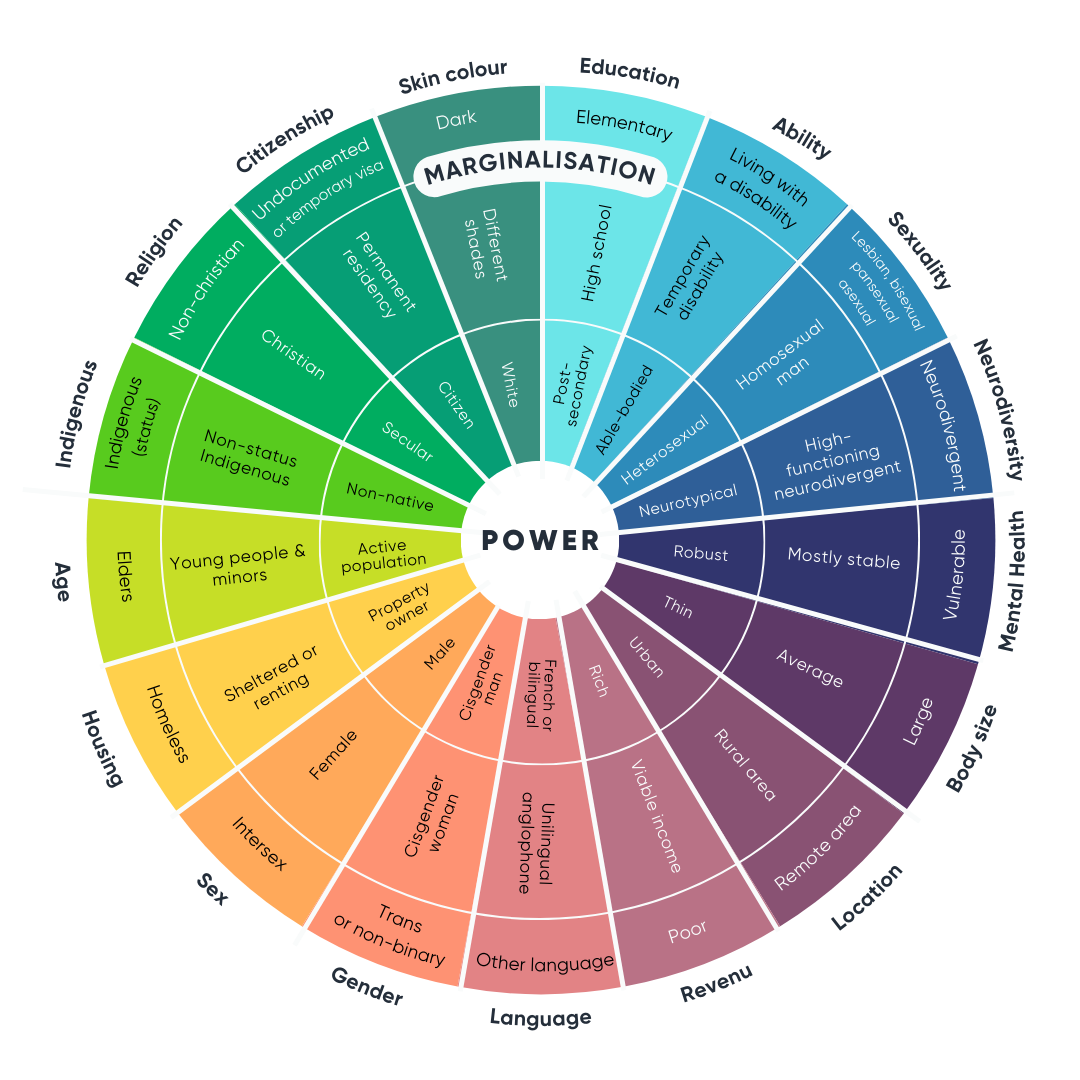
Educational institutions can receive training and support from the GÎM Feminist Roundtable to familiarise themselves with this tool and use it to improve inclusion within their organisations.
References
1. Francis Dupuis-Déri et la Fédération autonome de l’enseignement (2026). Enseigner à l’école au Québec face à la misogynie, l’antiféminisme, l’homophobie et la transphobie, https://www.lafae.qc.ca/public/file/2026_Rapport_montee_misogynie_homphobie_transphobie-Francis-Dupuis-Dery.pdf
2. Léa Beaulieu-Kratchanov (2023). « ”Moi, j’aime Andrew tate” : les jeunes à la merci des discours masculinistes en ligne », Pivot, article publié le 29 juillet 2023. https://pivot.quebec/2023/07/29/moi-jaime-andrew-tate-les-jeunes-a-la-merci-des-discours-masculinistes-en-ligne/
3. Léa Clermont-Dion (2025). Cyberviolences et discours masculinistes : enjeux, analyses et état des faits, 92e Congrès de l’ACFAS 2025.
4. David Waddington et Tessa Maclean (2025). Briser le cycle : Comprendre les discours masculinistes dans les écoles et les salles de classe, et y résister, 92e Congrès de l’ACFAS.
5. Samuel Tanner et François Gillardin (s.d.). « Les jeunes face aux discours masculinistes : 3 pistes pour les accompagner », Fondation Jeunes en tête, https://fondationjeunesentete.org/ressource/les-jeunes-face-aux-discours-masculinistes-3-pistes-pour-les-accompagner/
6. Fédération autonome de l’enseignement (s.d.). Les stéréotypes de genre, https://www.lafae.qc.ca/dossiers/stereotypes-de-genre
7. GRIS-Montréal (2025). Augmentation des niveaux de malaise. Ce que les élèves du secondaire pensent de la diversité sexuelle, 2017-2024, https://www.gris.ca/app/uploads/2025/01/GRIS_rapport-final_30jan2025.pdf
8. Léa Beaulieu-Kratchanov (2025). « Montée de l’homophobie : que se passe-t-il dans les écoles ? », Pivot, https://pivot.quebec/2025/01/30/montee-de-lhomophobie-que-se-passe-t-il-dans-les-ecoles/