Equality in Education
While education can be a vehicle for change and contribute to achieving gender equality, the school system can also reproduce inequalities and often reflects inequalities in society. Here, we present a portrait of education in the region, incorporating a gender-based analysis from an intersectional perspective (GBA+).
Although women in the region have a higher enrolment rate than men across all types of qualifications, they must study longer to earn an equivalent salary. In 2021, the percentage of people aged 25 to 64 without a qualification in the region was 16.4% for women and 24.3% for men [1]. More women than men had graduated from college, CEGEP or another non-university institution (24.4% of women and 15.4% of men) and had completed at least a bachelor’s degree (19.0% of women and 10.9% of men) [2].
School perseverance
Boys’ dropping out of school often receives a great deal of institutional and media attention, as it is generally higher than that of girls, particularly in more socioeconomically disadvantaged environments. The government’s dropout prevention plans therefore target boys.
The Fédération autonome de l’enseignement (FAE) notes an important point regarding dropout rates since the MEES bases its calculations on the number of youths who don’t have a high school degree at the age of 19 (21.6% for boys and 12.4% for girls). On its side, the Organisation for Economic Co-operation and Development (OECD) and Statistics Canada base theirs on the number of youths without a high school diploma at 24 and who aren’t enrolled in any educational establishment (10.3% for boys and 6.6% for girls). These different measurement methods paint a very different picture of the gap between boys and girls, which is narrowing considerably [3]. Therefore, there would be more boys who come back in school than girls who do the same.
We also notice that the impacts of dropping out of school hit girls harder than boys: the repercussions of dropping out of school seem to be felt more in the long term for girls and are reflected, among other things, in difficulty in finding a job, confinement to the domestic area, depression, and economic and psychological dependence on the partner [4]. We also notice that:
- Girls without a high school degree are more likely than their male peers to be excluded from the job market, to find insecure, low-paid jobs, or to be on welfare[5];
- As mothers’ schooling is an important determinant of educational success, dropping out of school among girls has consequences for all children [6];
- In the Gaspesie and the Magdalen Islands, mothers without a high school degree are more likely to give birth to low-weight babies than mothers with a higher schooling degree, no matter their age [7];
- Women with less than 8 years of completed studies have an employment rate 2 times lower than men with the same schooling level [8].
It is therefore of utmost importance, when looking at school perseverance, to consider the particularities of boys and girls who are dropping out.
What does student retention look like in Gaspesie and Magdalen Islands?
School leaving rates in the Gaspé and the Magdalen Islands
According to Ministère de l’Éducation et de l’Enseignement supérieur (MEES) data on young people exiting general education programs in the public system without a diploma or qualification, 27.1% of the boys and 15.8% of the girls (a gap of 11.3 percentage points) left school early in 2021-2022. Compared to data for the whole of Québec, boys in the region drop out of school more often (gap of 4.7 percentage points) while girls drop out less often (1.7 percentage points).
School leaving rates by school board
While the Gaspésie—Îles-de-la-Madeleine region presents trends that differ from what is seen elsewhere in Québec in terms of school-leaving rates, what is the situation for these parameters within the region’s school boards?
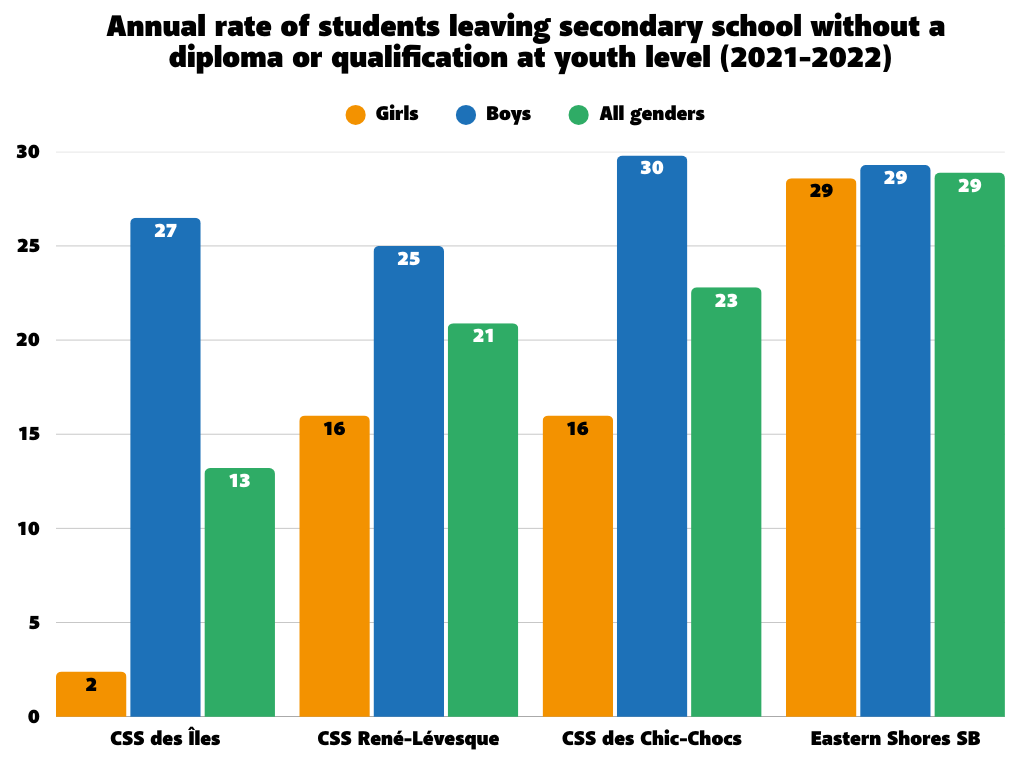
A look at the following graph reveals that besides Eastern Shores School Board, the gap between boys and girls’ dropout rates is higher in the region than in the province (8.3 percentage points), particularly at the CSS des Îles where the gap is of 24 percentage points. All the boys’ dropout rates are higher than the provincial average, and the same observations can be made for girls, except for the female Magdalen Islanders who perform very well.
School leaving rates by local territory (MRC and Communauté maritime)
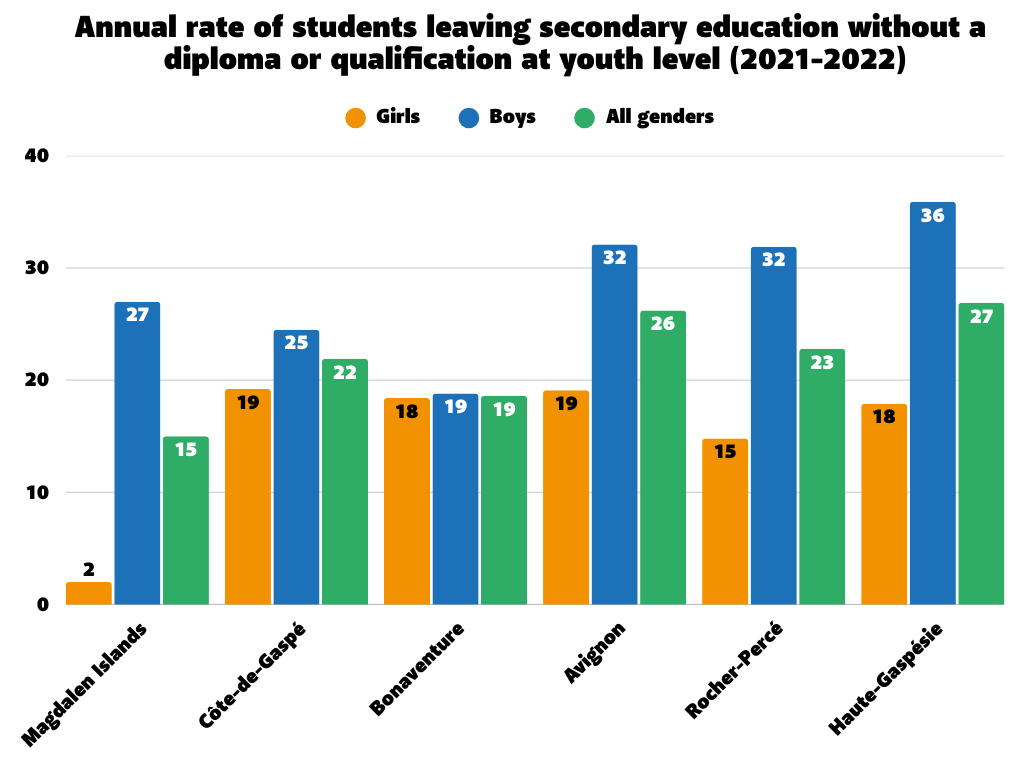
By looking at school leaving rates by RCM, we can more finely analyse the local realities that exist within Gaspésie—Îles-de-la-Madeleine. The highest school-leaving rates were observed in Haute-Gaspésie (35.9% for boys and 17.9% for girls). The lowest school-leaving rate for boys occurs in the MRC Bonaventure while for girls, the lowest rate occurs in the Communauté maritime des Îles-de-la-Madeleine (2%).
The largest gap between school leaving by girls and boys exists in Îles-de-la-Madeleine (25 points) while the lowest gap exists in the MRC Bonaventure (0.4 points), where school-leaving rates hover around 19%. It is no surprise that the highest dropout rates are found in the three most devitalized MRC of the region.
Indigenous realities
Unfortunately, data on school leaving and graduation for the three Mi’gmaq communities in the region are not available. In Québec overall, however, the annual school-leaving rate is very high in the three special-status school boards (CS Kativik, CS Crie et CSS du Littoral), where a large proportion of the students are Indigenous. In 2021-2022, these rates were respectively of 64.8%, 72.0%, and 14.6%, all genders combined [9]. The realities of the three Mi’gmaw communities of our region are also very different from those included in the special-status school boards. Many Mi’gmaw students attend schools from the CSS René-Lévesque, the CSS des Chic-Chocs and Eastern Shores School Board, while others attend community or New Brunswick schools, which make monitoring their school progression difficult.
Graduation and qualification rates in Gaspésie-Îles-de-la-Madeleine
To ensure a fair portrait of school perseverance in the region, we must also look at the rates of graduation and qualification after 7 years in the high school system.
In the region, in 2021-2022, 84.5% of girls and 80.2% of boys obtained a first degree or qualification 7 years after they’ve started high school. The graduation rate at the high school level is thus higher than the boys’ one, which is consistent with previous years data. The gap between graduation and qualification rates for girls and boys after seven years, for the 2015 cohorts, is 5.2 points [10]. It is the lowest gap of the last years [11]. This gap between genders is even lower than the one observed for the whole province for the same cohort, which is 8.3 percentage points.
Socioeconomic portrait and school retention
Knowledge of the socio-economic situation and job-related specificities that exist within the Gaspésie—Îles-de-la-Madeleine region can foster a comprehensive understanding of the school-leaving phenomenon and the perpetuation of gender stereotypes in the region. Socioeconomic disadvantage is one of the risk factors that most impact school leaving [12], while a higher school degree makes it easier to have access to better-paid jobs, particularly among men.
First of all, it is important to note that graduation rate varies according to the level of economic disadvantage of the different localities. For Quebec overall, the graduation rate after 7 years for the 2015 cohort is 81.6% (genders combined), while it is of 77.3% for the economically disadvantaged localities [12]. In the region, 67% of schools are considered economically disadvantaged, 27% are intermediate, and only 6% are from a privileged background [13].
Mothers’ schooling
The under-education in mothers has a recognised impact on their children’s obtaining a first diploma: children whose mothers have no diploma or who are undereducated are more likely to drop out than other children [14].
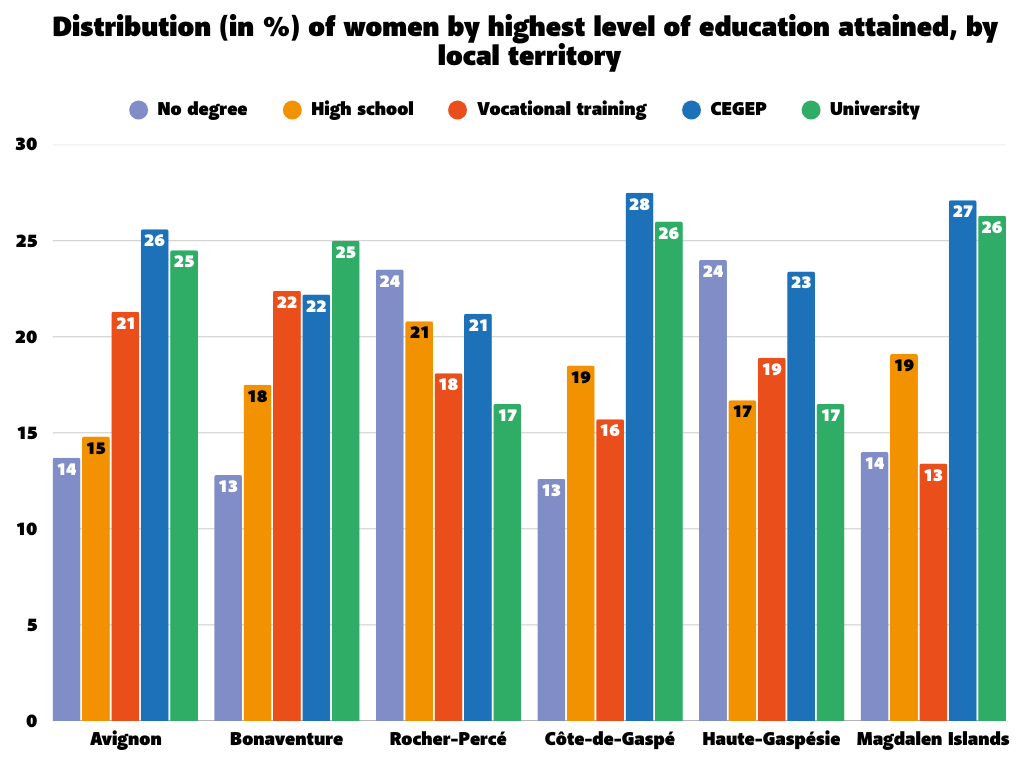
In Gaspésie—Îles-de-la-Madeleine, the schooling of mothers is evaluated by looking at the highest level of schooling obtained by women between 25 and 64 years of age [15]. In 2022, it is estimated that 13.6% of the women in this age group did not have any diploma and that about 14.1% had a secondary school diploma as their highest schooling level achieved [16].
In 2021, the level of schooling most often attained by women aged 25 to 54 is college, and women were proportionally more numerous (>24%) to have no degree at all in the MRC du Rocher-Percé and the MRC de la Haute-Gaspésie. It is in Côte-de-Gaspé where women are the most educated with a postsecondary graduation rate of 70 % [17].
At the provincial scale, mothers’ schooling level varies according to their ethnicity.
First of all, among Indigenous Peoples, “the proportion of indigenous mothers who don’t have a degree is close to 3 times higher (38%) that the same proportion for non-indigenous mothers (13%). This gap is also apparent when it comes to university-level diplomas. Indeed, 33% of non-Indigenous mothers graduated from university, while it is the case for 12% of Indigenous mothers. […] While mothers of preschoolers tend to be more educated than those with older children, the difference between Indigenous and non-Indigenous mothers is also significant. In fact, non-Indigenous mothers of toddlers are 4 times more university-educated than Indigenous mothers (9%) [18]”. If links can be made with the schooling level of the Indigenous population of the province, which is lower than the non-Indigenous population, this distinction between schooling levels of Indigenous and non-Indigenous mothers can also be explained by the fact that Indigenous women tend to have their children earlier in their life, and will therefore prioritize taking car of them before pursuing higher studies later [19]. Without regional data, we can only imagine that those trends are similar in Gespe’gewa’gi (Gaspesie).
Among immigrant women, at the Quebec scale, the situation is the opposite: they are generally more educated than mothers born in the province. The proportion of mothers born outside of Canada who are university graduates is nearly 10 points higher than the proportion of mothers born in Québec (39% vs 30%). Immigrant mothers are nearly twice as likely as native-born mothers to have higher education degrees (14% vs 8 %). Differences in educational attainment are also evident among mothers of pre-school children. Thus, 50% of immigrant mothers of preschoolers have a university degree, while it is the case for 37% of mothers born in the province. Differences in educational attainment between immigrant and native-born mothers can be partly explained by the administrative selection of immigrant families. Schooling level is a criterion for selecting immigrants in Canada [20].
Socio-economic levels of men and women
Even today, the male-female wage gap is still evident in Gaspésie—Îles-de-la-Madeleine. In fact, in 2023, women earned an average weelky wage of $953.66, representing 80% of the average for men, which was then of $1,192,14. This can be partly explained by the fact that the average hourly wage for women ($27.99) is lower than the average for men ($29.58) [21].
The Gaspésie—Îles-de-la-Madeleine English-speaking population holds the record for Canada’s poorest socio-economic status, taking into consideration low schooling rates, unemployment and the low-income cut-off [22].
Gender segregation in the workplace
Gender stereotypes not only exist in early childhood and elementary schools, they also influence youths’ career paths. The occupational segregation between men and women observed in Gaspésie—Îles-de-la-Madeleine is indeed strongly marked by these stereotypes.
According to the 2021 census, women of the region are present in higher numbers than men in traditionally female-dominated fields, such as “sales and services (30.7% vs 20.6%), business, finance and administration (17.8% vs. 5.5%), as well as teaching, law, and social, community and government services (20.8% vs 6.7%) […] They are also found in higher numbers in professions related to the health sector (16.8% vs 3.3%) [23]”.
On the opposite, when looking at traditionally male-dominated fields, “there are fewer women than men in occupations related to trade, transport, machinery and related fields (2.0% vs 31.8%). […] Women are also less numerous in in occupations related to manufacturing and utilities (3.2% vs. 8.8%), natural and applied sciences and related fields (1.8% vs. 6.0%), and natural resources, agriculture and related production (1.8% vs. 11.4%). Similarly, almost half as many women (0.8%) as men (1.9%) are members of the legislature or senior executives.” [23]
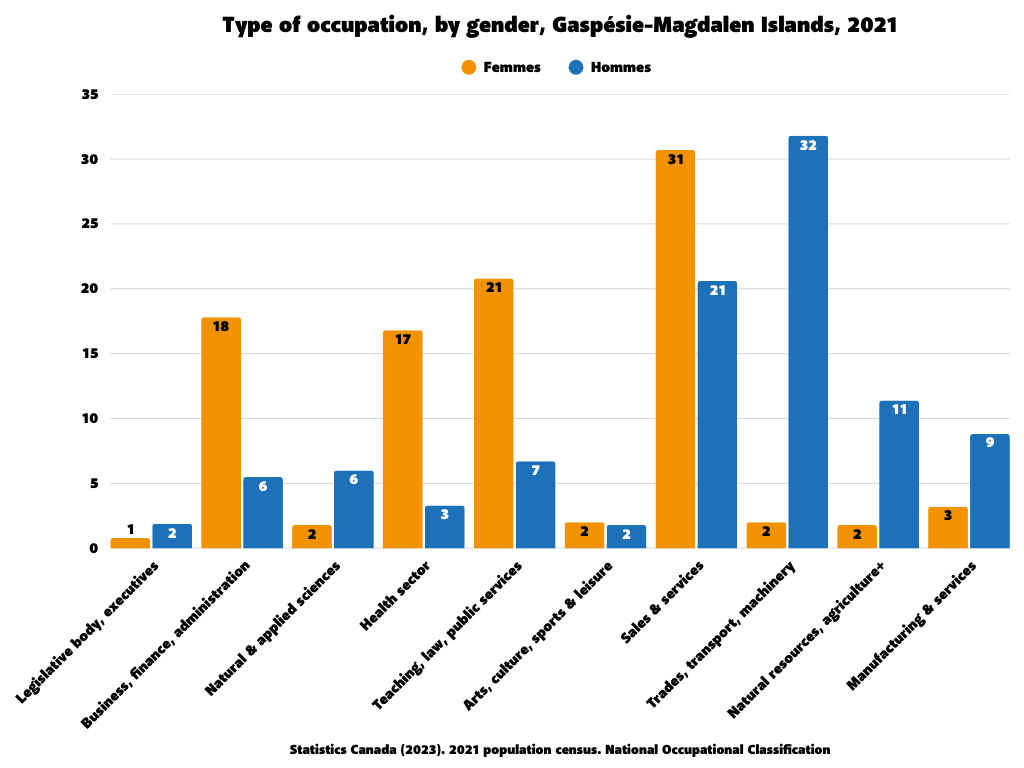
While the “Sales and services” occupation type is close to parity, we know that within this category, women mainly occupy subordinate positions, while men in the sales sector are more likely to sell automobiles and large appliances, their employment income being 50% higher than women in the same sector.” [24]
This striking segregation appears to exist as well at the provincial level, as suggested by the occupational choices of young people still at school, particularly in terms of secondary school-level occupational training and college-level technology programs [24].
Inclusion in educational environments : an overview
Beyond statistics in terms of school perseverance, levels of education achieved, income inequalities and gender segregation in the workplace, how is inclusion of everyone doing in educational environments, in the province and the region?
While the school system can reproduce social inequalities, it can also allow for social change by making the most out of its role in socializing students. We therefore wanted to share here an overview of the state of inclusion in our region’s schools, that has been developed from a needs assessment questionnaire sent to some of the educational staff of the region, and from a provincial literature review on the topic. This portrait will serve as a context for the tools presented on this website and will be presented during the training workshops offered during the Teaching equality for all project.
Gender equality
While there are disparities between girls and boys in terms of school retention and living conditions, both in the region and in Quebec, what do we know about their educational experience?
From early childhood, within their families or in educational settings (daycare centres or family environments), children already have different educational experiences depending on their gender. This is a particularly important time, as gender identity develops between the ages of 0 and 5, both for trans children and cis children (whose gender corresponds to the one they were assigned at birth). The gender-differentiated socialisation to which children are exposed from early childhood leads them to adopt stereotypical behaviours, attitudes and interests, resulting in differences in their development at a very early age.
According to the 2022 Quebec Survey on Child Development in Kindergarten (EQDEM), boys in the Gaspé Peninsula and the Magdalen Islands are proportionally more likely than girls to be vulnerable in the areas of ‘social skills,’ ‘emotional maturity,’ and ‘communication skills and general knowledge.’ In addition, by the time they enter primary school, boys have generally developed greater gross motor skills than girls, while girls have better fine motor skills. These differences cannot be explained by cognitive differences in the brain, but rather by the different educational experiences that children have, which lead them to progress more in certain areas of development than others, depending on their gender.
At the elementary level, this gender-differentiated education continues the socialisation of children according to their gender. According to a study conducted in several primary schools in the Quebec City region, “all boys have internalised a model of masculinity based on traditional stereotypes. According to these stereotypes, a boy must be athletic, undisciplined, indifferent to academic results and able to defend himself. Boys who refuse to conform to this model are excluded from the group. [25]” According to the study, ”behaviours perceived as masculine boost the self-esteem of most boys and make them popular with their peers, but they distance them from academic success and lock them into a limiting mould. [25]”
Our local partners and the staff interviewed as part of the regional needs analysis conducted for the project also mentioned some discomfort among teaching staff in applying dress codes, with some finding them too “permissive” and others finding them too restrictive for girls.
The rise of masculinist discourse online also affects elementary school students, who have access to these ideas via social media and video game servers, despite the age requirement for accessing these platforms (13 years old for Tiktok, for example).
It is at the high school level that our local partners and the staff interviewed most often mention the (sometimes growing) adherence of certain adolescents to the views of masculinist influencers [29]. Across Quebec, recent studies have found that 20% of young Quebecers consider feminism to be an attempt to control the world and that 34% of young Quebecers adhere to a masculinist position [30]. When controversial issues (such as masculinist attitudes) are raised in class, teachers tend to adopt a neutral, impartial stance and use cautious approaches [31].
According to Samuel Tanner and François Gillardin of the UdeM School of Criminology, “masculinist discourse conveys a rigid and violent view of gender relations. Far from being harmless, it can have harmful effects on both boys and girls, especially during adolescence, a period when identity is still being formed. […]
This discourse can generate intense pressure to conform to unrealistic and toxic models. In young people, whose judgement is still developing, this can lead to:
- Low self-esteem
- Risky behaviour
- Fear of rejection or of not meeting others’ expectations
- In some cases, a trivialisation of violence or inequality [32]”
To define their self-concept, young people will undergo several experiences and needs during adolescence that will consolidate their psychosexual development and lead them towards greater autonomy. During this period, gender stereotypes can represent both constraints and opportunities for exploration. The rise of masculinist discourse leads to widespread adherence to gender stereotypes, particularly among young men from economically disadvantaged backgrounds.
Young people studying in vocational training or college-level programs traditionally dominated by males once again find themselves alongside a minority of girls and women, as professions in the region remain largely segregated by gender. Women face several obstacles when joining these programs, including:
- Fear of being judged by others;
- Sexist or sexual jokes and comments, which can escalate to sexist and sexual harassment;
- The constant need to prove oneself;
- The questioning of their good academic results or jealousy from their colleagues regarding their academic success, which is sometimes attributed to their seduction of teachers;
- The contrast effect, which accentuates their feeling of being watched;
- Balancing family and studies;
- A professional culture that (over)values physical strength and traditional masculinity.
Among the inspiring initiatives promoting inclusion are Plein air au féminin and Femmes fières en foresterie, two groups for female students studying adventure tourism and forestry at the Gaspé campus of Cégep de la Gaspésie et des Îles.
2SLGBTQ+ Communities
With the rise of far-right and masculinist rhetoric, particularly on social media and other online platforms, there has been a noticeable resurgence of homophobia and transphobia in Quebec in recent years. This trend observed in the field has also been confirmed by the most recent annual study by GRIS-Montréal, which surveyed more than 35,000 secondary school students in several regions of Quebec [33]. The study found that “33.8% of respondents said they would feel uncomfortable if they learned that their best friend was a lesbian—a marked increase from 2017–2018, when the same proportion was 15.2%. For a gay friend, the proportion is even more pronounced: 24.7% in 2017, compared to 40.4% in 2024.
While these new data are unprecedented in Quebec for GRIS, they are not entirely surprising. At a time when masculinist rhetoric is rampant, from social media to the highest political spheres, it is predictable that more and more young people will be influenced by it.” [34]
As part of the training needs analysis conducted for the Teaching Equality project with volunteer teaching staff in the Gaspé Peninsula and the Magdalen Islands, 50% of respondents said they were “somewhat uncomfortable” welcoming and supporting trans and non-binary students, and 12.5% felt this same level of comfort with students of diverse sexual orientations and those living in same-sex or transparent parent families. This makes it the greatest training need identified among all the diversity issues surveyed. One respondent added a nuance: “I am personally comfortable welcoming all this diversity, but less so when it comes to supporting them properly… and I see a need to support other students in welcoming them (and their parents).”
The Association LGBT+ Baie-des-Chaleurs, which acts as an advisory partner for the Teaching Equality project and offers workshops and support to several schools and young people in the region, points out that there is still resistance among some members of school teams, who are reluctant to talk about non-binarity and sometimes even to intervene in cases of transphobic incidents targeting students.
Neurodiversity
Teachers in the region are generally well informed about the various diagnoses associated with neurodiversity and teach students with learning disabilities to the best of their ability. However, interventions targeting neurodiverse students, such as those with ADHD, autism or dyslexia, often involve accommodations that create an excessive workload for teaching staff. Rather than accumulating accommodations, Maude Ouellet, an occupational therapist at the Centre de services scolaires René-Lévesque who supports the Teaching Equality project, recommends taking proactive measures based on a universal design for learning, which allows us to start from the margins with methods that are ultimately good for everyone. However, this method is not practised everywhere in the Gaspé Peninsula and the Magdalen Islands, and much work remains to be done to overcome prejudices and address the fears and resistance of school teams who rightly wish to avoid an excessive workload. The vast majority (87.5%) of respondents to our needs analysis questionnaire said they were ‘fairly comfortable’ or ‘very comfortable’ welcoming and supporting students with neurodiversity.
Immigration
Like other regions of Quebec, Gaspésie and the Magdalen Islands have seen a marked increase in recent years in the number of immigrants, many of whom arrive with their children or with the intention of starting a family. As a result, more immigrant students are being welcomed into schools. However, there are very few teachers who are immigrants or racialized, which leads to situations where a lack of sensitivity and blind spots on racial issues are noted among staff, students, parents and staff members who are immigrants or racialized.
Among the teaching staff surveyed during the training needs analysis, 12.5% said they felt somewhat uncomfortable welcoming and supporting students from immigrant backgrounds. Many of them perceive the integration of these students as an extra workload, especially since many immigrant students arrive at different times of the year and their education must be aligned with the curriculum of their country of origin, which differs from that of Quebec.
During the needs assessment, local organisations that welcome and support immigrants mentioned that many students experience culture shock and challenges in learning the language. Immigrant parents also reported that their children are monitored more closely by teaching staff and that rules are applied differently to racialized students for the same behaviour, causing immigrant children to experience minority stress, which undermines their self-esteem, learning and inclusion in the community.
Across Quebec, researcher Fabian Salazar, who conducted a study on the experiences of young people from Latin America in Quebec, also noted challenges related to racism and microaggressions experienced by racialized youth. Integration classes, for example, make them feel left out, separated from others, and led them to experience social isolation rather than inclusion. It should be noted that these results are in an urban context, since very little research has been done in rural areas [35]. However, these obstacles do not prevent immigrant students from persevering and succeeding, and even outperforming non-immigrant students, as shown in the following table [36] :
| Status | Total | Boys | Girls |
|---|---|---|---|
| First generation immigrants | 83,7 | 80,2 | 87,1 |
| Second generation immigrants | 88,5 | 84,8 | 92,3 |
| Non-immigrants | 83,2 | 79,0 | 87,6 |
| Unknowned status | 82,2 | 76,5 | 88,2 |
| Total | 84,1 | 80,1 | 88,4 |
Secondary school graduation and qualification rates by gender and immigration status of students, 2015 cohort followed until 2021–2022, for all of Quebec
Mi’gmaq
Not all children from the Mi’gmaq communities of Listuguj and Gesgapegiag attend schools in their communities (Gespeg has no reserve territory, so no community school). Many parents choose to send their children to French- or English-language schools in the region, which leads to more diverse classrooms and encourages teaching staff to develop their intercultural skills. The Inter-Community Harmony Project, launched in Listuguj and Pointe-à-la-Croix in 2002 and implemented between 2019 and 2021 in Gesgapegiag and New Richmond, has enabled the English-speaking, Mi’gmaq and French-speaking communities to get to know each other better. However, the training needs analysis questionnaire shows that there is still work to be done, as 12.5% of respondents said they were “somewhat uncomfortable” welcoming and supporting Indigenous students. According to interviews with parents and individuals involved in the school system, there is still a lack of knowledge about history from an Indigenous perspective among staff, and anti-racism skills need to be developed.
References
1. MESS (2024). Portrait socioéconomique de la région Gaspésie-Îles-de-la-Madeleine – Recensement de 2021, Gouvernement du Québec, https://cdn-contenu.quebec.ca/cdn-contenu/adm/min/emploi-solidarite-sociale/publications-adm/imt/portrait-socioeconomique/11-gaspesie/PR_SOCIO_GIM_2021.pdf
2. Statistique Canada. (2023). Profil du recensement, Recensement de 2021 : Gaspésie-Îles-de-la-Madeleine. https://www12.statcan.gc.ca/census-recensement/2016/dp-pd/prof/details/page.cfm?Lang=F&Geo1=ER&Code1=2410&Geo2=PR&Code2=24&Data=Count&SearchText=Gaspesie–Iles-de-la-Madeleine&SearchType=Begins&SearchPR=01&B1=All&GeoLevel=PR&GeoCode=2410&TABID=1
3. FAE et Relais-femmes (2015). Le décrochage scolaire des filles : La possibilité d’agir, la nécessité de le faire !, https://www.lafae.qc.ca/public/file/201505_decrochage-des-filles_rapport-analyse.pdf, p. 6.
4. FAE (2012). Les conséquences du décrochage scolaire des filles, https://www.lafae.qc.ca/public/file/decrochage-scolaire-filles_guide_201203.pdf, p. 2.
5. Fédération autonome de l’enseignement. (2012). Les conséquences du décrochage scolaire des filles : une étude exploratoire. https://www.lafae.qc.ca/wp-content/uploads/2012/06/decrochage-scolaire-filles_guide_201203.pdf
6. MINISTÈRE DE LA FAMILLE, « La scolarité des familles au Québec en 2016 », Bulletin Quelle famille ?, volume 8, numéro 2, 13 pages.
7. Dubé, N. (2017). La santé et le bien-être de la population de la Gaspésie-Îles-de-la-Madeleine. Direction de la santé publique de la Gaspésie-Îles-de-la-Madeleine, 213 p. https://www.cisss-gaspesie.gouv.qc.ca/wp-content/uploads/2020/02/La_sant%C3%A9_et_le_bien-%C3%AAtre_de_la_population_de_la_Gasp%C3%A9sie- %C3%8Eles-de-la-Madeleine_-_%C3%89dition_2017.pdf
8. Ministère de la Santé et des Services sociaux. (2018). Taux d’emploi selon le niveau d’études : Statistiques de santé et de bien-être selon le sexe – Tout le Québec. http://www.msss.gouv.qc.ca/professionnels/statistiques-donnees-sante-bien-etre/statistiques-de-sante-et-de-bien-etre-selon-le-sexe-volet-national/taux-d-emploi-selon-le-niveau-d-etudes/
9. Gouvernement du Québec (2025). Atlas du décrochage scolaire, https://infogeo.education.gouv.qc.ca/public/Atlas_Decrochage/
10. Ministère de l’Éducation du Québec (2023). Taux de diplomation et de qualification par cohorte de nouveaux inscrits au secondaire, https://www.education.gouv.qc.ca/fileadmin/site_web/documents/PSG/statistiques_info_decisionnelle/Rapport-diplomation-qualif-sec-2023.pdf
11. Secrétariat à la condition féminine (2024). Portrait statistique de l’égalité entre les hommes et les femmes à l’échelle régionale – Gaspésie-Îles-de-la-Madeleine, https://cdn-contenu.quebec.ca/cdn-contenu/adm/org/SCF/publications/ADS/portraits-regionaux/Portraits-regionaux-11Gaspesie-2024.pdf
12. Réseau réussite Montréal (2019). Défavorisation, https://www.reseaureussitemontreal.ca/defavorisation/
13. Ministère de l’Éducation du Québec (2024). Indices de défavorisation des écoles publiques 2023-2024, https://www.education.gouv.qc.ca/fileadmin/site_web/documents/PSG/statistiques_info_decisionnelle/Indices-defavorisations_2023-2024.pdf
14. Fédération autonome de l’enseignement et Relais-Femmes (2015). Le décrochage scolaire des filles : La possibilité d’agir, la nécessité de le faire !, https://www.lafae.qc.ca/public/file/201505_decrochage-des-filles_rapport-analyse.pdf, p. 12.
15. Il est difficile de connaître de façon précise et fiable le niveau de scolarité des mères puisque, jusqu’en 2005, l’avis de naissance demandait aux mères quel est « le nombre d’années de scolarité de la mère », alors que depuis 2005, le formulaire leur demande plutôt quel est le « dernier niveau de scolarité réussi par la mère » et 4 choix de réponse sont proposés: primaire, secondaire, collégial ou universitaire. Or, il se peut que certaines, qui avaient terminé, p. ex., leur 3e secondaire, aient coché la case « secondaire » alors que la case « primaire » aurait plutôt dû être cochée. C’est pourquoi la mesure utilisée est le plus haut niveau de scolarité atteint de la population de 25 à 64 ans, dont le libellé n’a pas changé au fil des ans.
16. Secrétariat à la condition féminine (2024). Portrait statistique de l’égalité entre les hommes et les femmes à l’échelle régionale – Gaspésie-Îles-de-la-Madeleine, https://cdn-contenu.quebec.ca/cdn-contenu/adm/org/SCF/publications/ADS/portraits-regionaux/Portraits-regionaux-11Gaspesie-2024.pdf
17. Statistique Canada, Recensement 2021, Plus haut niveau de scolarité, selon la région géographique : Divisions de recensement. https://www150.statcan.gc.ca/t1/tbl1/fr/tv.action?pid=9810038701&pickMembers%5B0%5D=2.1&pickMembers%5B1%5D=3.5&pickMembers%5B2%5D=4.3
18. MINISTÈRE DE LA FAMILLE, « La scolarité des familles au Québec en 2016 », Bulletin Quelle famille ?, volume 8, numéro 2, page 6. https://www.mfa.gouv.qc.ca/fr/publication/Documents/Bulletin-Quelle-Famille-vol8n2.pdf
19. Jeannette Martin, Vice-présidente de Femmes autochtones du Québec, communication personnelle, 25 mars 2025.
20. Ministère de la Famille, « La scolarité des familles au Québec en 2016 », Bulletin Quelle famille ?, volume 8, numéro 2, page 7. https://www.mfa.gouv.qc.ca/fr/publication/Documents/Bulletin-Quelle-Famille-vol8n2.pdf
21. Institut de la statistique du Québec. (2024). Rémunération hebdomadaire et horaire des employés selon le sexe, régions administratives et ensemble du Québec. https://statistique.quebec.ca/fr/document/remuneration-hebdomadaire-et-horaire-des-employes-regions-administratives/tableau/remuneration-hebdomadaire-horaire-employes-regions- administratives-ensemble-du-quebec#tri_sal=4&tri_sexe=10
22. Mary Richardson et Joanne Pocock (2018). Les communautés anglophones de la Gaspésie-Îles-de-la-Madeleine – Un profil régional, https://casa-gaspe.com/wp-content/uploads/2019/10/CASA-Regional-Profile-FRENCH_Gasp%C3%A9sie-les-Iles-2018.pdf
23. Secrétariat à la condition féminine (2024). Portrait statistique de l’égalité entre les hommes et les femmes à l’échelle régionale – Gaspésie-Îles-de-la-Madeleine, p. 12. https://cdn-contenu.quebec.ca/cdn-contenu/adm/org/SCF/publications/ADS/portraits-regionaux/Portraits-regionaux-11Gaspesie-2024.pdf
24. Ruth Rose (2016). Les femmes et le marché du travail, https://sac.uqam.ca/upload/files/publications/femmes/Les%20femmes%20et%20march%C3%A9%20du%20travail%20Resume_ETUDE.pdf
25. Gagnon, C. (1999). Pour réussir dès le primaire : filles et garçons face à l’école, Les Éditions du Rémue-ménage, Montréal, p. 29.
26. Secrétariat à la condition féminine (2018). « Identité de fille ? Identité de garçon ? », Portail sans stéréotypes, https://www.quebec.ca/famille-et-soutien-aux-personnes/enfance/developpement-des-enfants/consequences-stereotypes-developpement/boite-outils
27. BBC (2018). No more boys or girls, can our kids go gender-free ?
28. Catherine Vidal (2017). « Cerveau, sexe et préjugés », dans Louise Cossette, Cerveau, hormone et sexe. Des différences en question, Les Éditions du Remue-Ménage, 9-28.
29. Léa Beaulieu-Kratchanov (2023). « ”Moi, j’aime Andrew tate” : les jeunes à la merci des discours masculinistes en ligne », Pivot, article publié le 29 juillet 2023. https://pivot.quebec/2023/07/29/moi-jaime-andrew-tate-les-jeunes-a-la-merci-des-discours-masculinistes-en-ligne/
30. Léa Clermont-Dion (2025). Cyberviolences et discours masculinistes : enjeux, analyses et état des faits, 92e Congrès de l’ACFAS 2025.
31. David Waddington et Tessa Maclean (2025). Briser le cycle : Comprendre les discours masculinistes dans les écoles et les salles de classe, et y résister, 92e Congrès de l’ACFAS.
32. Samuel Tanner et François Gillardin (s.d.). « Les jeunes face aux discours masculinistes : 3 pistes pour les accompagner », Fondation Jeunes en tête, https://fondationjeunesentete.org/ressource/les-jeunes-face-aux-discours-masculinistes-3-pistes-pour-les-accompagner/
33. GRIS-Montréal (2025). Augmentation des niveaux de malaise. Ce que les élèves du secondaire pensent de la diversité sexuelle, 2017-2024, https://www.gris.ca/app/uploads/2025/01/GRIS_rapport-final_30jan2025.pdf
34. Léa Beaulieu-Kratchanov (2025). « Montée de l’homophobie : que se passe-t-il dans les écoles ? », Pivot, https://pivot.quebec/2025/01/30/montee-de-lhomophobie-que-se-passe-t-il-dans-les-ecoles/
35. Fabian Salazar (2025). « Parcours scolaires et professionnels des immigrants issus d’Amérique latine au Québec : inégalités systémiques et ressources culturelles mobilisées », Colloque Racisme systémique, migration et parcours scolaire des jeunes issu·es de l’immigration et des minorités ethniques, 92e Congrès de l’ACFAS.
36. Ministère de l’Éducation (2023). Taux de diplomation et de qualification : nouveaux inscrits au secondaire, Gouvernement du Québec, https://www.education.gouv.qc.ca/fileadmin/site_web/documents/PSG/statistiques_info_decisionnelle/Rapport-diplomation-qualif-sec-2023.pdf